
Preschool Enrollment, Spending Hit Record Highs, but Access and Quality Gaps Persist
The national preschool landscape remains uncertain, according to new research from the National Institute for Early Education Research.

;)
Education news and commentary, delivered right to your inbox.
Sign up for Â鶹¾«Ʒ newsletter.
Join our zero2eight Substack community for more discussion about the latest news in early care and education.
Although the 2023-24 school year saw historic gains for early childhood education, the national landscape for preschool remains uncertain. The (NIEER) has released its , which for the past 22 years has provided a comprehensive, vital portrait of American preschool education. Its analysis shows that state-funded preschool programs nationwide have not only recovered from COVID-19’s devastating impacts, but reached a record high in both enrollment and spending during the 2023-24 school year.
But those increases are skewed by a small number of states making progress; others are not doing as well. Quality remains uneven from state to state and even within states, quality and availability often are a matter of ZIP code. While some states have increased funding, enrolled more students, and worked to meet national quality benchmarks, others have lagged, offering programs that meet fewer national quality benchmarks — or none at all.
Shifting sands at the federal level have left much of the sector uncertain about what the future might hold and how the Trump administration’s to the Department of Education, the Department of Health and Human Services and other federal agencies might affect and other early childhood programs. NIEER reports that eliminating Head Start funding would mean a decline of more than 10 percentage points in access to public preschool in several states and more than 20 percentage points in some.
The 2024 State of Preschool Yearbook underscores how essential it is for states to proactively prioritize and expand investments in early childhood, and a special section highlights four states — Alabama, Michigan, New Mexico and Oklahoma — a bipartisan mix that NIEER identifies as pre-K leaders and strong examples others can emulate.
Though this might seem like a clarion call for states to step up, W. Steven Barnett, NIEER’s senior director and founder, says it is not that simple. For many states, Head Start is the foundation their preschool programs are built on and it is on the .
“Federal Head Start money is about the same magnitude of all state pre-K spending,” he says. “The notion that states could replace that funding, especially overnight, is not realistic. If you had said, ‘Over 10 years, this is going to go away,’ maybe. But overnight? It would be a disaster.” In some states, like Mississippi and West Virginia, 23% of 3- and 4-year-olds are in a Head Start program.
“We don’t know if they’re going to zero out the program, but if they do, the money to serve a half a million 3- and 4-year-olds disappears. In some states that’s almost a quarter of the kids who benefit the most,” Barnett adds. “They say, ‘You need to pull yourselves up by your bootstraps,’ but also, ‘I’m taking your boots away.’ Where are these states going to find the money to replace that?”
Setting New Records
The 2023-24 school year saw new records set for funding and enrollment for state-funded preschool programs. Across the country, enrollment increased by more than 111,000 children nationally to reach 1,750,995 children, an increase of 7% from the previous year. This marked an all-time enrollment high with 37% of 4-year-olds and 8% of 3-year-olds enrolled. Despite the increase for 3-year-olds though, most state pre-K programs continued to serve primarily (or only) 4-year-olds.
States spent more than $13.6 billion on preschool in the 2023-24 school year, which included $257 million in federal COVID-19 relief funds, an increase of nearly $2 billion over the prior year. State spending on preschool increased in all but five states that have a public preschool program. California, New Jersey, New York and Texas led funding, spending $1 billion or more on preschool. Together, these four states accounted for 51% of all state spending on preschool.
State spending per child increased in all but eight states with preschool programs. Including state, local and federal sources, spending per child was $8,856, an inflation-adjusted increase of $635 per child that reflects a strong growth in state funding as federal recovery dollars decreased.
Room for Improvement
Over the past two decades, NIEER’s research has consistently found that higher quality preschool programs yield increased and enduring benefits for children’s learning and development. Based on classroom data, monitoring, surveys and assessments, the institute’s research has developed 10 benchmarks that measure the quality standards for preschool programs that support that growth.
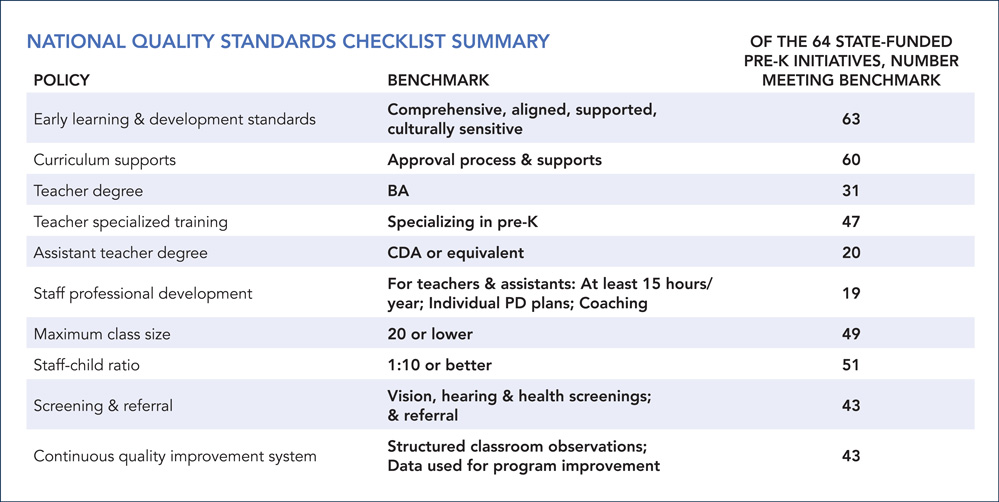
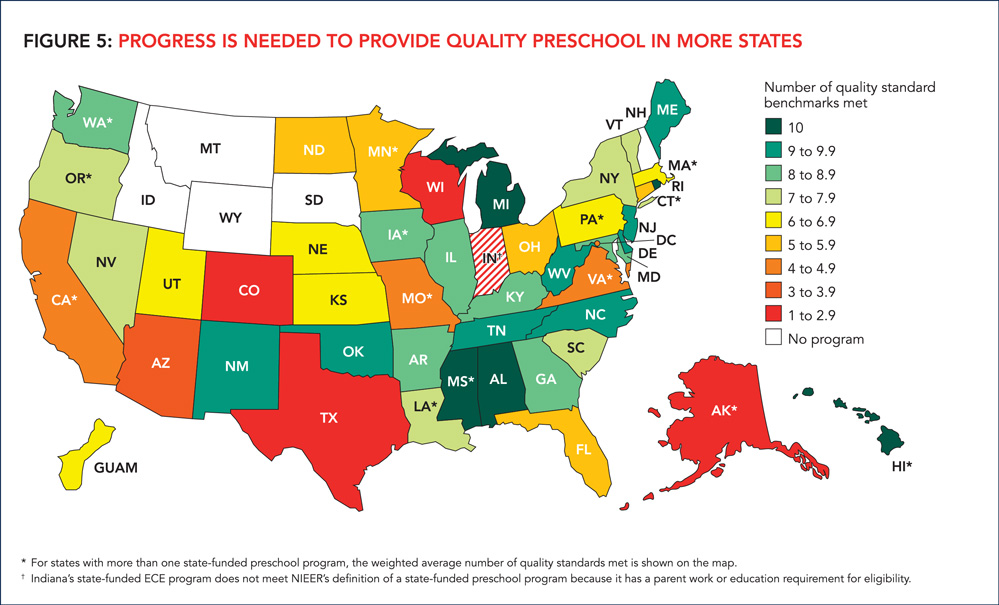
The 2024 Yearbook finds that 2 1/2 times more children in the U.S. attended lower-quality programs that met five or fewer of those benchmarks than children attending programs that met nine or 10, underscoring again the tremendous variation across states and zip codes.
According to the report, many states aren’t hitting the quality standards that would set their programs up to provide that give pre-K its greatest value for children and taxpayers. Five states, for example, have no state-funded program in 2023-24; eight states spent less than half the cost needed to meet minimum quality standards. Others just aren’t serving enough young learners.
“If you do pre-K right, you put in place a foundation for future success in school and in life,” Barnett says. “We have strong causal evidence linking quality pre-K to educational attainment, whether you graduate from high school or go to college, and strong causal evidence that links educational attainment to other positive life outcomes. Not just how much money you make, but good pre-K sets in motion this chain where people will live longer, healthier lives. Taxpayers make out great when that happens.”
Barnett adds: “If that [foundation] is not there, then we’re focusing much more on remediation, special education, dropout prevention, incarceration — all these negative expenditures rather than positive outcomes. If you’re meeting five or less benchmarks and you’re not spending enough money to pay for a quality program, it may look like you’re saving money, but you’re throwing it away.”
Alabama, Hawaii, Michigan, Mississippi and Rhode Island are the only states nationwide to meet all 10 benchmarks. Other states come close, meeting nine benchmarks. On the other hand, 21 state-funded preschool programs meet five or fewer of these quality standards.
Information Gathering
Over the years, the NIEER State of Preschool Yearbook has become a sort of Bible for legislators, school officials, researchers and other early learning stakeholders to understand what’s going on in the sector. Barnett points out that people might hear “survey” and think the reporting is based on sampling. In reality, he says, it’s more like a census because it consists of 300 questions sent to state school administrators. By the time all the appendices are organized, the final report is inches thick.
“There have been changes in state governments where no one with institutional memory was left,” Barnett says. “They used the Yearbook to figure out what their own policies were — which is fair because they’re the ones that filled it out in the first place. The Yearbooks have been a long-standing partnership with administrators. It’s as much their product as it is ours. We write up the narrative up front, but all the state page narratives are constructed with state administrators to make sure we represent their programs correctly.”
Going Forward
Preschool spending has reached an all-time high, but fiscal uncertainty could reverse the trend, the report warns. Several top economists weak growth in the U.S. economy, or even a recession, which, combined with federal cutbacks could create powerful headwinds for state pre-K programs. It wouldn’t be the first time: According to the report, the 2008 recession led to lower pre-K funding for more than half a decade. Barnett says it’s a critical time for states to learn from each other and take proactive steps with policies and programs that prepare their youngest learners for their best possible future.
Did you use this article in your work?
We’d love to hear how Â鶹¾«Ʒ’s reporting is helping educators, researchers, and policymakers.
K.C. Compton worked as a reporter, editor and columnist for newspapers throughout the Rocky Mountain region for 20 years before moving to the Kansas City area as an editor for Mother Earth News. She has been in Seattle since 2016, enjoying life as a freelance and contract writer and editor.
