Community Colleges Across NC Are Collaborating to Build Up Regional Workforce

;)
Education news and commentary, delivered right to your inbox.
Sign up for Â鶹¾«Ʒ newsletter.
Get stories like this delivered straight to your inbox. Sign up for Â鶹¾«Ʒ Newsletter
North Carolina’s 58 community colleges have traditionally competed in some ways with one another for students — and the resulting .
But as and colleges emphasize the need for accessible student services, among other reasons, that competitive relationship is increasingly shifting to a formally collaborative one.
“Exemplary institutions have kind of taken the onus on themselves to become not only providers for students, but also to be able to serve as a convener and a problem solver for the region and for their community,” said Tess Henthorne, senior program manager at the
On a national scale, Henthorne sees these collaborations taking place to develop talented workers and higher-paying jobs in a region.
Such collaborations pay dividends for students, she said, but not necessarily for the colleges themselves.
“It just takes a lot more work on the part of the college to take that step and have that mindset shift,” Henthorne said. “Because community colleges aren’t necessarily incentivized through their funding structures to do that work.”
RTP Bio
In North Carolina, a new workforce development collaboration between and recently secured .
That partnership, RTP Bio, is an effort between the two colleges to unite their .
BIG NEWS: $1.2 million in federal funding is headed to NC-04 for the RTP Bio Workforce Development Project!
This collab between & will provide the skills training necessary to connect students w/ quality jobs in the rapidly growing biotechnology sector.
— Rep. David E. Price (@RepDavidEPrice)
With some overlapping geographical boundaries, Wake Tech and Durham Tech often compete to attract students. Now, the colleges will work together to connect students to regional biotech employers. The Research Triangle Park is the country’s fifth largest biotechnology hub, according to a .
“Collaborations like this — when there’s a lot of synergy, as in this case because of our institutions and because of our connections to Research Triangle Park — make everybody stronger,” Wake Tech President Scott Ralls said. “There are things that each of our institutions have and somewhat focus on that the other doesn’t have, and may not need to have as the other one’s putting a focus there. We can collectively support each other in what is this huge sector of our economy that’s so relevant in the two areas.”
In addition to resources from each school, the RTP Bio announcement listed an annual commitment of $40,000 from North Carolina pharmaceutical giant Eli Lilly to support the program. Lilly recently broke ground on a $474 million pharmaceutical manufacturing facility in Durham County. The company’s annual pledge will go toward resources, student scholarships, and faculty development, according to the colleges.
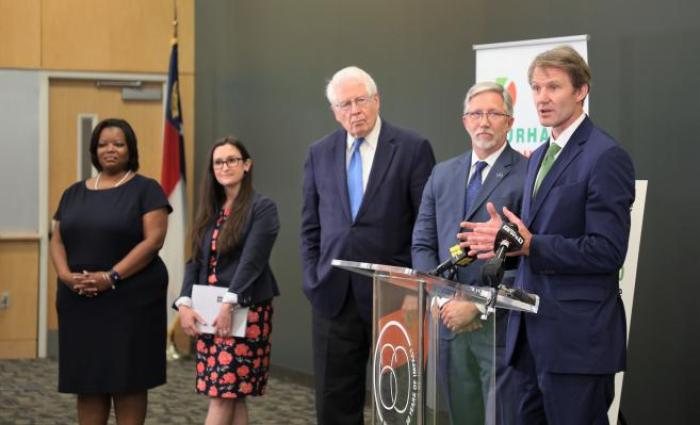
The collaboration’s goal is to attract more potential biopharma students and address growing employment needs in the RTP’s life sciences. In 2020, more than 11,000 biotechnology jobs were created in the RTP, according to
The initiative’s joint programs include associate degree transfer arrangements, the delivery of short-term and customized workforce training, and apprenticeships. Additionally, RTP Bio will create new life sciences pathways for high schoolers and support biotechnology-related career development across the counties served by the two colleges. Under the partnership, the colleges also plan to share building and faculty resources.
“Between our students and the employers in this area, county boundaries and college service areas don’t mean a whole lot — certainly not like they mean to the community colleges,” Durham Tech President J.B. Buxton said. “As employers and potential employees are working all around the greater Triangle region, we really need to come together to provide those pathways. And we’re going to do a better job at meeting that demand together than to try to serve them separately.”
‘The importance of regional collaboration’
While the history of collaboration between community colleges is not new, such a concerted financial partnership to build programming is unique.
“Well, we’ve seen it on the transfer side, for sure,” Aspen Institute Vice President Josh Wyner told EdNC regarding pathways for students to transfer from a two-year to four-year school. Wyner is also the founder and executive director of the institute’s college excellence program.
“The challenge that we see is that the capacity of different community colleges to be nimble in delivering these workforce credentials varies so dramatically, that the chances two colleges will be able to deliver the same quality in the same place is somewhat limited,” he said. “Colleges are not designed very well either to cede authority over curriculum development and standards for the program to somebody else, and those that have developed the best workforce programs are not incentivized to share those with anybody else. Nor is there a mechanism for them to do that — so you see it sporadically.”
Aspen Institute Vice President Josh Wyner
RTP Bio is one of the most significant collaborations between N.C. community colleges, according to college leaders involved in the program, but others exist.
Last week, The Golden LEAF Board of Directors awarded (CCCC) nearly $500,000 for a regional truck driving and logistics program. That program – a collaborative effort between Central Carolina, , and community colleges – will provide commercial truck driver and short-term logistics courses and serve Chatham, Harnett, Hoke, Lee, Moore, and Randolph counties. The project uses a scaled shared-resources model to incentivize the collaboration.
“Golden LEAF recognizes the importance of regional collaboration to provide cost-effective workforce solutions for skills in high demand by industry,” said Scott Hamilton, President and Chief Executive Officer of the Golden LEAF Foundation. “This effort by Central Carolina Community College, Sandhills Community College, and Randolph Community College will support industry by training a minimum of 60 students for transportation and logistics credentials per year.”
The foundation also recently supported students seeking a commercial driver license (CDL) at a training program in western N.C.
’s (CCC&TI) truck driver training program has operated since 1990 — when it started with one truck and a handful of students. Now, the program has 90-plus pieces of equipment, and in the last decade, more than 2,000 CDL drivers graduated from the program.
CCC&TI’s truck driving course is offered throughout the year at multiple locations, . The class is taught at nine counties and eight other community colleges: , , , , , Isothermal, Halifax, and community colleges.
Last spring, the joint program at (HCC) certified 10 CDL students.
“Community colleges are not only economic drivers in a community but they also are institutions that can change people’s lives quickly,” said David Forester, HCC acting president and vice president of administrative services/CFO, in a release from the college. “The CDL program serves as a great reminder of the dramatic benefits of short-term training improving the lives of students.”
‘This is really the future’
Last October, (MTCC), (ICC), Foothills Workforce Development Board, and Centro Unido Latino Americano launched another large collaborative workforce development initiative.
, funded by a $1.498 million grant from the U.S. Department of Labor’s Workforce Opportunities in Rural Communities (WORC) program, recruits and serves economically disadvantaged individuals. The grant allocated funds at both community colleges to add high-tech instructional simulation equipment in health care, manufacturing, and construction trades programs. The colleges could add work-based learning staff to create on-the-job training opportunities for students.
Nonprofit Centro Unido Latino Americano is helping connect Hispanic communities with training and education offered by both colleges. The nonprofit also received funding to hire a Latino Workforce Coordinator to recruit individuals to English language acquisition classes and high school equivalency and career training opportunities.
“We are excited about the opportunities this will create in our communities,” ICC President Margaret Annunziata said last October. “We are appreciative of all of the partners involved and of the supportive vision of the Department of Labor for helping us realize this possibility.”
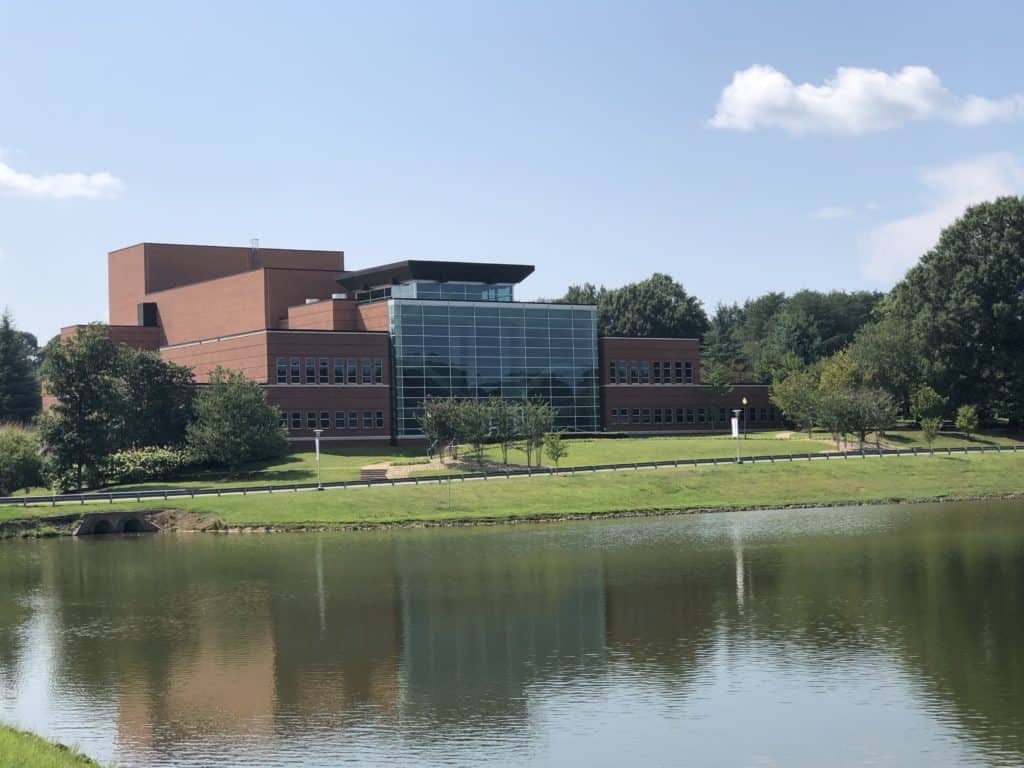
During recent N.C. State Board of Community Colleges meetings, Board members discussed creating and funding similar student support positions. In such cases, those employees would serve multiple community colleges in a region.
At , North Carolina Community College System President Thomas Stith said he wants to encourage regional partnerships. Board Chair Burr Sullivan emphasized incentivizing financial collaboration, so that one college doesn’t shoulder the burden of a partnership. He cited CCC&TI’s contributions to the truck driver program as an example.
At Durham Tech, Buxton said a foundation of cooperation between campuses will be crucial in expanding to more formal partnerships.
Ralls said RTP Bio is a “more focused step” between Durham and Wake Tech to address workforce development. Still, he said, a previously existing economic ecosystem in the region is what made the initiative possible.
Both presidents are proud of what RTP Bio will add for their students and communities. They also hope the partnerships between community colleges across the state will continue to grow and receive necessary support.
“This is really the future of what will become normal for how we address workforce opportunities that span county boundaries,” Buxton said. “Whether it’s Durham Tech with Wake Tech or it’s Durham Tech with and … this kind of collaborative approach to how we make sure that people in our backyard have access to jobs across a region is where we’re all trying to move, and I think that’s very exciting for the people in our communities.”
This first appeared on and is republished here under a Creative Commons license.
Did you use this article in your work?
We’d love to hear how Â鶹¾«Ʒ’s reporting is helping educators, researchers, and policymakers.